The break comes at about one minute and twenty-six seconds into “Amen, Brother”. The band drops out. Gregory Coleman keeps playing. Four bars. Then the band comes back and it is gone.
There is not much to it. A kick drum. A snare. A ride cymbal. One open cymbal near the end. That is all.
Four bars
Bars one and two
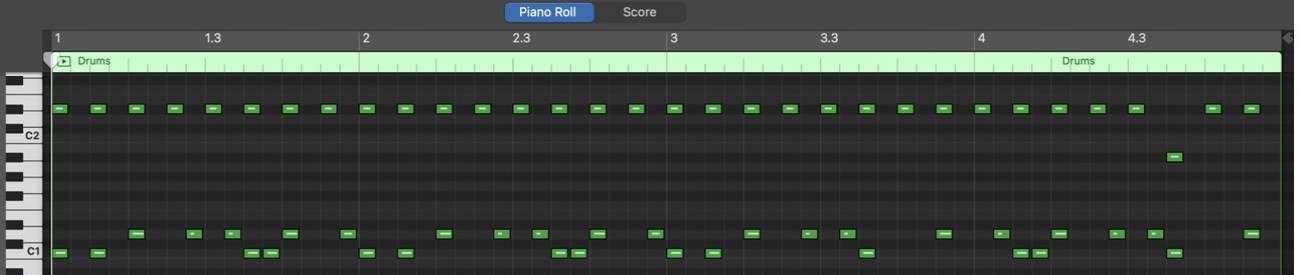
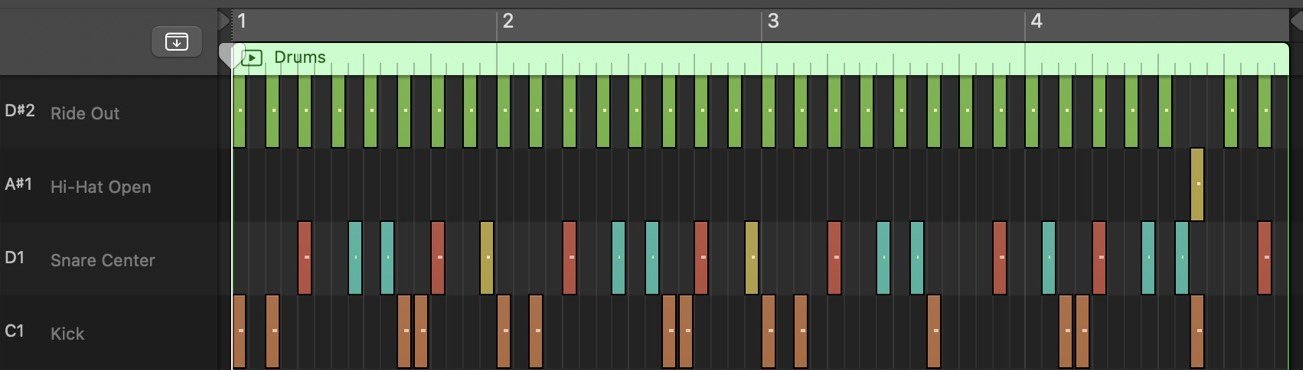
The same bar, played twice. The ride keeps eighth notes, steady as a clock. The kick lands on one and just after. It comes back late in the bar, twice, close together. The snare cracks on two and four.
Between the loud snares sit soft ones. Ghost notes. Barely touched. You feel them more than you hear them. They make it roll.
Bar three
It starts the same, then holds back. The last snare does not come on four. It waits half a beat and lands late. The bar leans forward.
Bar four
Here it comes apart. No kick on one. A ghost snare slips in just after it. The kick comes off the beat. On the and of three the ride gives way to a splash of open cymbal. Some hear a crash. Our score writes an open hi-hat. The last snare is late again. Then it is over.
No click
Coleman played to no click track. The break runs at about 136 to 138 beats a minute. Inside it, the notes drift. One count, by Ethan Hein, puts the sixteenths anywhere from about 120 to 165. Our score says 140, a round number for the page. The record is not round. That drift is the feel. A machine can copy the notes. The feel is harder.
In the box
The same MIDI file, opened three ways. Nothing changed but the view. Get the file below and open it yourself.

What you can do with it
Slow it down
In 1986 Ultimate Breaks & Beats put it out slower, to suit hip-hop. Slow a record and the pitch drops with it. The kick goes fat. There is room for words.
Speed it up
In Britain in the early nineties it went the other way. Faster, then faster again. Samplers like the Akai S950 could stretch time, changing speed and pitch apart. The snare went to a crack. The kick went thin. A big bass line went under it. That was jungle, and then drum and bass.
Chop it
Cut the four bars into single hits. Put them back in a new order. Same words, new sentence. The Chop button below does it in one go.
Swing it
Push every other sixteenth a little late. A straight grid starts to shuffle.
Take it apart
Take out the ghost notes and it goes stiff. Take out the kick and it floats. Try it.
Play with the Break
The grid below is the Amen. The drums are ours, not his. Your browser makes them from nothing. Press play. Then change it.
Downloads
Our own transcription, written down from the record. It is not the 1969 recording. Whether a drum pattern can be owned is not settled. See Copyright.
- amen-break-midi-v1.0.0.mid 1 KB
MIDI file. Opens in GarageBand, Logic, Ableton and most others. General MIDI drum notes, channel 10. - amen-break-score-v1.0.0.pdf 29 KB
The score, one page, to print. - amen-break-score-v1.0.0.musicxml 21 KB
The score as MusicXML, for MuseScore, Sibelius, Dorico or Finale.
Sources
- Amen break, Wikipedia. Where the break falls in the track; tempo about 136 BPM; jungle and drum and bass in the early 1990s.
- Ethan Hein, Amen break listening guide (2025). Tempo about 138 BPM; sixteenth-note timing from about 120 to 165; the late backbeats in bars three and four; Ultimate Breaks & Beats slowing it for hip-hop.
- Reverb, The Samplers and Breakbeats Behind ’90s Jungle/Drum & Bass. The Akai S950 and its time-stretch.